FIELD MANUAL // 06
Agreements
How pacts work: slots, durations, and the four ways one can end
This chapter covers what agreements are once they’re active: how durations and slots work, and the four ways a pact can end. The terms of each agreement type live in the Card Reference; sending and answering offers is covered in Negotiation.
How agreements work
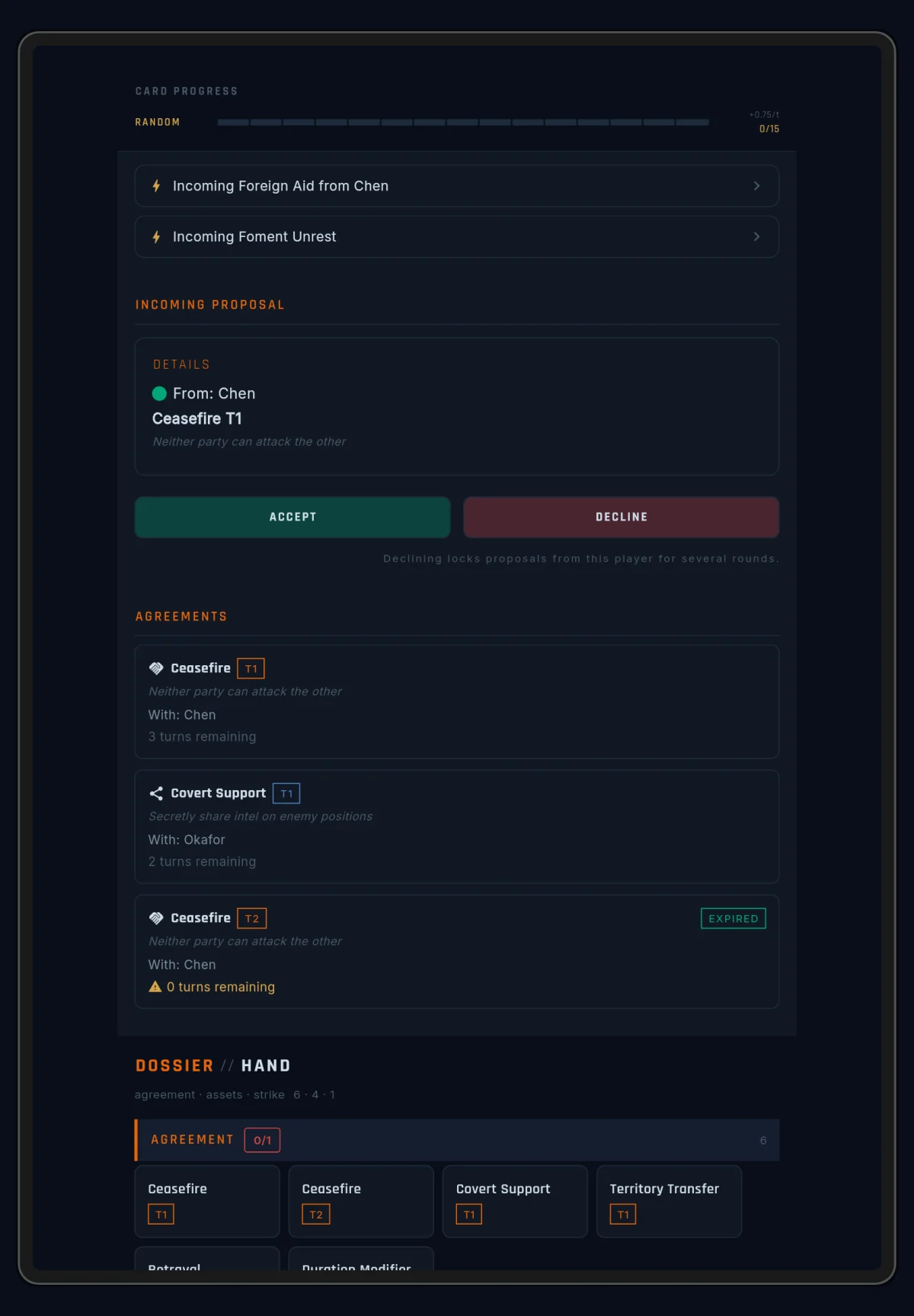
An agreement is a successful proposal: a binding pact between two players with real consequences in the game. The proposer plays an agreement card (Ceasefire, Territory Transfer, Covert Support, or Manufacturing Partnership), fills its slots, and the offer waits for the other player. Once accepted, the agreement is active and counts down over a fixed number of turns.
Offers are answered at the recipient’s turn start, never in between.
When their turn begins, a banner points them at the offer and Accept
and Decline wait at the top of their hand. The proposer sees a small
PROP↻ chip until the answer comes — and their committed cards stay
locked until then.
Slots
Agreement cards carry slots that take value cards. The slots are the price of the deal: cards committed from your hand to make it real. The proposer fills their slots when proposing; the recipient fills theirs when accepting. Higher-tier agreements ask for more.
The four agreement types
Each type gets a full block (terms, numbers, counters) in the Card Reference. In one line each:
- Ceasefire — neither side can attack the other. The whole table knows, and the two of you see each other’s territories.
- Territory Transfer — hands one territory over, garrison intact.
- Covert Support — secretly sends troops, sized by the recipient’s own income.
- Manufacturing Partnership — both sides deploy more and draw cards slower. Public.
Four ways an agreement ends
- It runs out. The counter reaches zero on one of the proposer’s turn starts. The pact dissolves cleanly; nobody pays anything.
- Betrayal. One side plays a Betrayal card to break it early. The breaker pays the commitment penalty (half deploy for twice the remaining turns, at least 3 turns) and the other side gets nothing extra.
- Elimination. When one party is eliminated, all their agreements dissolve at once. The survivor keeps whatever benefits already landed, and loses the pact going forward. See Winning.
- A Manufacturing Partnership dies on aggression. Attack your partner and the deal voids itself — unevenly. See below.
Manufacturing Partnership void
A Manufacturing Partnership has no peace clause — it’s an economic deal, not a truce. But attacking your own partner makes a nonsense of it, and the game enforces that the moment it happens. When one partner attacks, bombs, or besieges the other:
- The victim walks away whole. Their deploy bonus and their card slowdown both lift at once, as if the deal had never been signed.
- The aggressor keeps paying. They lose the deploy bonus but keep the card slowdown for the deal’s remaining turns. The timed-effects reminder shows them the cost, turn by turn.
- Everyone finds out. A public event names the aggressor and what they did. The victim also gets a push notification: their partner attacked them, and the deal is broken.
No Betrayal penalty applies — there was no peace promise to break. The lopsided ending is the point: the victim isn’t punished twice for being attacked, and the aggressor can still choose to outgrow a partnership, at a price the whole table can see.